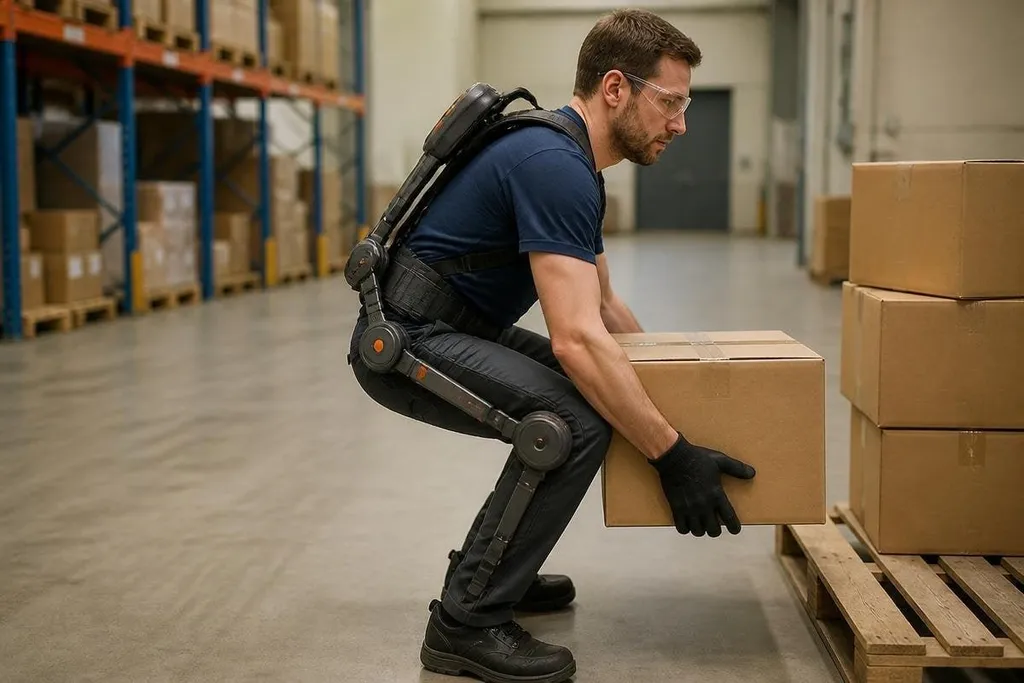
A robotic exoskeleton adds powered support around a worker’s joints while they move. It can take some load from the back, hips, shoulders, or legs during tasks such as lifting, carrying, or working with the arms raised.
Quick read
- The frame senses movement and adds force at the right joint.
- Fit, task design, battery life, and worker comfort decide whether it helps on a real shift.
What the robot does
A powered exoskeleton uses sensors, motors, and a control system. Sensors detect movement or force, then the controller sends commands to motors that assist the worker’s motion.
The support must arrive at the right moment. If the motor pushes too early, the worker may feel resistance. If it reacts too late, the person carries the load without useful help. Good control should feel steady while the worker keeps control of the task.
Different designs support different body areas.
A back-assist frame can help during repeated bending and lifting. An arm-support frame can hold some of the arm’s weight during overhead work. A leg-assist frame can help with squatting or standing, though its value depends on the task and the floor conditions.
The robot doesn’t remove the load from the workplace. It changes how that load reaches the worker’s body.
Where workers may feel the benefit
Manual handling places repeated force on the body. An exoskeleton can spread some of that force through a frame and into stronger parts of the body, depending on its design and fit.
That may help with repeated lifts, long periods of bent posture, or work that keeps the arms above shoulder height. The benefit is tied to the motion the frame supports. A back-assist model may do little for a task that mainly strains the wrists or shoulders.
This matters to an operations manager because a device that helps one task can get in the way during another. Workers may need to remove it before climbing, driving, moving through tight spaces, or doing work that requires fast changes in posture.
That fit question needs a record of the device, the task, and the worker’s movements. Exoskeleton reports from Robot24.com can connect a maker’s support claim to the work it is meant to do, including the spaces where the device may limit movement. The next section looks at those physical limits.
The limits are physical
An exoskeleton adds weight to the body. It also needs power, charging, cleaning, and regular checks. A battery-powered frame may need a plan for charging or swapping batteries during a shift, but the needed runtime depends on the model and the work cycle.
Fit creates another limit. The frame must match the worker’s body and move with them. Poor adjustment can create pressure at the hips, shoulders, or legs. A device that feels fine during a short trial may become uncomfortable after hours of repeated movement.
Safety needs a task review before rollout. The frame must not block an emergency stop, limit escape routes, or create a snag risk around machinery. Training should cover how to put it on, adjust it, remove it, and respond when the battery or control system stops working.
Evidence also needs careful reading. A short demonstration can show that a robot assists one movement. It cannot prove that the same device lowers injury risk across a full workforce or a full shift.
A buying checklist for work sites
Before choosing a robotic exoskeleton, check these points with the people who will wear it:
- Name the task: record the lift, posture, work height, cycle time, and space around the worker.
- Map the limits: check stairs, vehicles, ladders, emergency stops, tight aisles, and protective clothing.
- Test the fit: include the body sizes, clothing, footwear, and adjustments found on the intended work team.
- Plan the power: confirm battery runtime, charging time, spare batteries, and what happens during a fault.
- Measure the result: compare comfort, task time, error rates, and worker feedback before and after use.
The comparison should cover the work method too. Better lift training, a height-adjustable bench, a lift table, or a change in product flow may solve the task with less equipment.
I'd choose an exoskeleton only after the work has been measured and the device has passed a full-task trial. The next useful proof is not a polished demo; it is a documented shift showing where the frame helps, where workers remove it, and what changes after four weeks.